
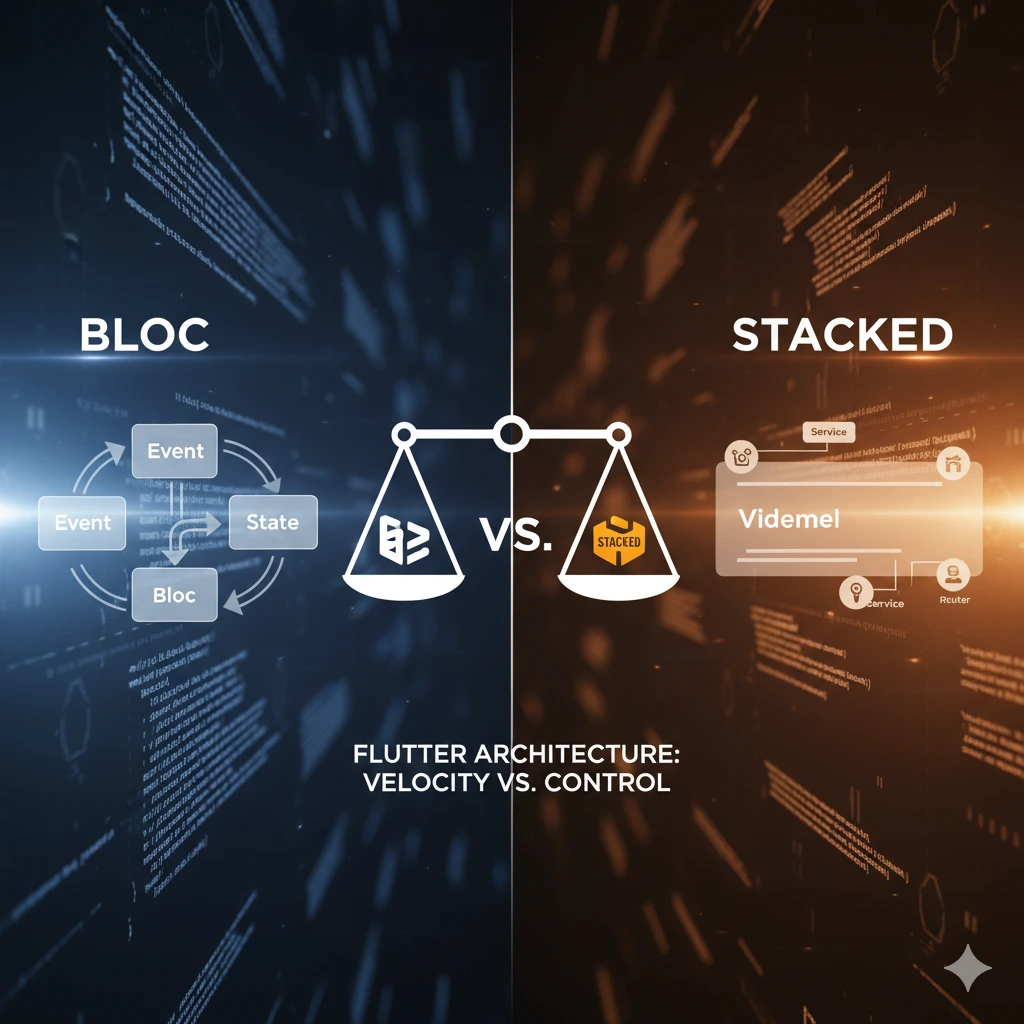
When building a robust Flutter application, the architectural decision between BLOC (Business Logic Component) and Stacked MVVM can significantly impact long-term maintenance and development speed. While both are excellent, a detailed comparison is necessary to align the architecture with the project’s goals
💡 A New Scenario: The “CoinFlow” Investment Platform
Let’s imagine developing CoinFlow, a Flutter application for tracking cryptocurrency portfolios, executing trades, and generating complex, auditable transaction reports.
| Feature Type | CoinFlow Requirement | Optimal Choice |
|---|---|---|
| State Complexity | Handling real-time market data, order books, and managing multi-step transaction flows. | BLOC |
| Auditability/Compliance | Generating mandatory, auditable logs for every trade and portfolio change. | BLOC |
| Development Team | A large, distributed team of 15+ developers working on specialized features. | BLOC |
| Prototyping/MVPs | A separate module for user profile management (a simple CRUD screen). | Stacked |
BLOC vs. Stacked: Choosing the Right Architecture for a Fintech App
When building a robust Flutter application, the architectural decision between BLOC (Business Logic Component) and Stacked MVVM can significantly impact long-term maintenance and development speed. While both are excellent, a detailed comparison is necessary to align the architecture with the project’s goals.
💡 A New Scenario: The “CoinFlow” Investment Platform
Let’s imagine developing CoinFlow, a Flutter application for tracking cryptocurrency portfolios, executing trades, and generating complex, auditable transaction reports.
| Feature Type | CoinFlow Requirement | Optimal Choice |
| State Complexity | Handling real-time market data, order books, and managing multi-step transaction flows. | BLOC |
| Auditability/Compliance | Generating mandatory, auditable logs for every trade and portfolio change. | BLOC |
| Development Team | A large, distributed team of 15+ developers working on specialized features. | BLOC |
| Prototyping/MVPs | A separate module for user profile management (a simple CRUD screen). | Stacked |
🔬 Architectural Comparison
The key differences between BLOC (Event-Driven) and Stacked (MVVM) heavily influence their suitability for a complex application like CoinFlow.
1. Structure and Boilerplate (BLOC’s Trade-Off)
| Aspect | BLOC Pattern | Stacked MVVM |
| State Handling | Uses explicit Events and States (e.g., TransactionStarted, TransactionSuccess, TransactionError). This provides a strict unidirectional flow. | Uses Reactive Properties in the ViewModel (e.g., _isBusy, _portfolioValue). Direct method calls replace events. |
| Boilerplate/Files | High—Requires separate files for Event, State, and Bloc for every feature (min 3 classes). | Low—Logic is consolidated into a single ViewModel file per feature. |
CoinFlow Context: For managing trade flows, BLOC’s strict, multi-file approach is beneficial. The verbosity ensures that every state transition is explicitly documented and auditable, which is crucial for compliance
2. Tools and Development Experience
| Aspect | BLOC Pattern | Stacked MVVM |
| DI & Routing | Manual GetIt setup for dependency injection (DI) and external packages (e.g., AutoRoute) for navigation. | Auto-Generated DI and Routing via the stacked_generator and @StackedApp annotation. |
| Debugging | Built-in support for Time-Travel Debugging (replaying events and states). | No Time-Travel debugging support. |
| Learning Curve | Steep, requiring understanding of streams, events, and states. | Moderate, leveraging familiar MVVM concepts. |
CoinFlow Context: While Stacked offers faster development and a lower learning curve , CoinFlow’s complex bug tracking (e.g., diagnosing why a trade failed) makes BLOC’s Time-Travel Debugging invaluable.
⚖️ Final Decision for CoinFlow
For the CoinFlow Investment Platform, BLOC is the superior choice.
- Auditability & Compliance: The event-driven model creates a natural, auditable log of user actions and state changes, satisfying regulatory requirements.
- Scalability & Team Size: The strict pattern prevents “architectural drift” and provides clear separation of concerns, which is essential for a large team (10+ developers) ensuring consistency across 100+ features.
- Complex State: Features like market data streaming and complex state machines are best handled by BLOC’s event sourcing and stream-based architecture.
However, if CoinFlow were a simple utility app for tracking personal spending (CRUD-heavy, small team, tight deadline), Stacked would be the clear winner due to its rapid development velocity and low overhead. The optimal choice always depends on the project’s priorities.
💻 Code Example: Fetching a List of Classes
The goal is to load and display a list of classes, and show a loading state while fetching.
1. The BLOC Pattern (Event-Driven)
BLOC requires a minimum of three files to manage the state and logic for this one feature: event, state, and bloc.
A. The Events (my_classes_event.dart)
This defines the user’s input/action.
Dart
// Example of a minimal BLOC Event file
abstract class MyClassesEvent extends Equatable {
  const MyClassesEvent();
}

class FetchMyUpcomingClasses extends MyClassesEvent {
  // We'll use Equatable to compare events
  @override
  List<Object> get props => [];
}
B. The States (my_classes_state.dart)
This defines all possible states the UI can be in.
Dart
// Example of a minimal BLOC State file
abstract class MyClassesState extends Equatable {
  const MyClassesState();
}

class MyClassesInitial extends MyClassesState {
  @override
  List<Object> get props => [];
}

class MyClassesLoading extends MyClassesState {
  @override
  List<Object> get props => [];
}

class MyClassesLoaded extends MyClassesState {
  final List<Classe> classes;

  const MyClassesLoaded({required this.classes});

  @override
  List<Object> get props => [classes];
}
C. The BLOC (my_classes_bloc.dart)
The central business logic component that maps Events to States.
Dart
// Example of a minimal BLOC file (102 lines in the PDF study) [cite: 77]
class MyClassesBloc extends Bloc<MyClassesEvent, MyClassesState> {
  final MyClassesRepository _repository;

  MyClassesBloc({required MyClassesRepository repository})
      : _repository = repository,
        super(MyClassesInitial()) {
    // Map the FetchMyUpcomingClasses event to the corresponding handler function [cite: 79]
    on<FetchMyUpcomingClasses>(_onFetchMyUpcomingClasses);
  }

  Future<void> _onFetchMyUpcomingClasses(
    FetchMyUpcomingClasses event,
    Emitter<MyClassesState> emit,
  ) async {
    // 1. Emit the Loading state [cite: 89]
    emit(MyClassesLoading());

    // 2. Fetch data from the repository
    final response = await _repository.getMyUpcomingClasses();

    // 3. Emit the Loaded or Error state based on the result [cite: 90, 91]
    if (response.isSuccess) {
      emit(MyClassesLoaded(classes: response.data));
    } else {
      emit(MyClassesError(message: response.errorMessage)); // Assumed state
    }
  }
}
2. The Stacked MVVM Pattern (Reactive Services)
Stacked consolidates the business logic and reactive properties into a single ViewModel file, significantly reducing the file count and boilerplate.
The ViewModel (my_classes_viewmodel.dart)
The ViewModel holds the logic and exposes reactive data directly for the View to consume.
Dart
// Example of a minimal Stacked ViewModel file (78 lines in the PDF study) [cite: 56]
class MyClassesViewModel extends ReactiveViewModel {
  // Inject the service using the locator (auto-generated) [cite: 67]
  final _classService = locator<ClassService>();

  // Register the service to listen for changes (auto-rebuilds when service data changes) [cite: 67, 101]
  @override
  List<ListenableServiceMixin> get listenableServices => [_classService];

  // Getters expose the reactive data from the service to the UI [cite: 68]
  List<Classe> get upcomingClasses => _classService.userUpcomingClasses;

  // Simple booleans for UI state, no state classes needed [cite: 70]
  bool get hasUpcomingClasses => upcomingClasses.isNotEmpty;

  // Actions are direct method calls, replacing BLOC Events [cite: 73]
  Future<void> loadUpcomingClasses() async {
    // runBusyFuture manages the 'isBusy' reactive property automatically
    // The UI can show a loading spinner while 'isBusy' is true
    await runBusyFuture(
      _classService.fetchClasses(
        userFilter: 'my_classes',
        timeFilter: 'upcoming',
      ),
    );
  }

  // Example of built-in Navigation service usage [cite: 75, 160]
  void navigateToClassDetails(Classe classe) {
    navigationService.navigateToClassDetailsView(classId: classe.id);
  }
}
Key Differences Illustrated
- Boilerplate: BLOC requires four files (Event, State, Bloc, View) for the basic feature, while Stacked uses a single ViewModel file.
- Logic Flow: BLOC uses the
add()method to send anEvent, which is processed by theBlocand results in a newStatebeingemitted. Stacked uses a direct method call (loadUpcomingClasses()), and theViewModelis notified reactively when its associatedServicedata changes, triggering a rebuild. - State Representation: BLOC uses explicit State classes (
MyClassesLoading,MyClassesLoaded). Stacked uses simple getters (hasUpcomingClasses) and the built-inisBusyproperty fromViewModelto represent UI states.
My opinion is that Stacked is generally the optimal choice for the majority of new Flutter projects, especially those led by startups, small-to-medium teams, or those focused on rapid iteration and CRUD-heavy business applications.
Here is the reasoning behind this opinion:
1. Superior Development Velocity and Low Overhead 🚀
Stacked prioritizes developer productivity, directly translating to faster time-to-market.
- Drastic Code Reduction: The migration study showed a 44% reduction in lines of code and a 36% reduction in files after switching from BLOC to Stacked. This is because Stacked minimizes the boilerplate required, consolidating logic into a single ViewModel file per feature, versus the 3-5 files (Event, State, Bloc) required by BLOC.
- Built-in Services: Stacked includes built-in services for essential functions like Navigation, Dialogs, and BottomSheets, which require additional packages or custom solutions in BLOC, further accelerating development.
- Faster Task Completion: Stacked was consistently ~50% faster for common tasks like creating a new feature screen (20-30 mins vs. 45-60 mins in BLOC) and adding a new service/repository (15 mins vs. 30 mins in BLOC).
2. Lower Barrier to Entry and Onboarding 🎓
Stacked is more accessible to developers, which is critical for growing teams.
- Learning Curve: Stacked has a moderate learning curve because it uses the familiar MVVM pattern, whereas BLOC has a steep learning curve requiring a deep understanding of reactive streams, events, and states.
- Faster Onboarding: Onboarding a new developer takes significantly less time with Stacked (1-1.5 days vs. 2-3 days for BLOC), resulting in a ~40% improvement in this metric.
The BLOC Exception (When BLOC is Recommended) 🚨
My opinion flips entirely when a project meets specific criteria that prioritize strictness and auditability over speed. BLOC is the objectively better choice for large-scale enterprise applications where the framework’s inherent complexity becomes a necessary advantage.
- Large Enterprise/Team: Applications with 100+ features or teams of 10+ developers benefit from BLOC’s strict patterns to prevent architectural drift.
- Complex State & Debugging: Apps requiring time-travel debugging or handling complex state machines (like fintech or real-time systems) leverage BLOC’s event sourcing and streams.
- Regulatory Needs: For projects with strict compliance requirements, BLOC’s auditable event logs and predictable state flow are mandatory.
In summary, unless a project falls into the ‘BLOC Exception’ category, Stacked provides the most balanced and efficient development experience for the modern Flutter ecosystem.
Leave a Reply